
Dry Stack vs. Wet Slip: Which Makes More Money Per Square Foot?
Every marina developer with a waterfront site ends up asking the same question about dry stack vs wet slip storage. Which model produces more revenue per square foot? Here is the short answer: dry stack wins on revenue density. Wet slips win on revenue per boat.
The most successful marinas are built on the right mix of both. This article compares how each model earns, what each costs to build and operate, and how developers decide the ratio.
Dry Stack vs. Wet Slip Storage: The Core Difference
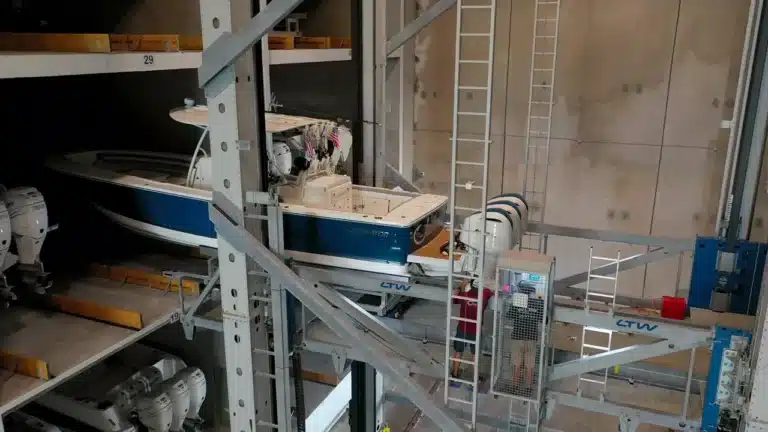
Dry stack storage keeps boats in racks inside or under a structure on land and launches them on demand. Wet slip boat storage keeps boats in the water at a dock, ready to board.
That one difference sets up everything else. Dry stack uses the vertical dimension. A rack building holds several boats on the footprint one boat would occupy at ground level. Wet slips consume linear waterfront. One boat per slip, one slip per stretch of dock. Almost every number in the economics below traces back to that single physical fact.
How Each Model Generates Revenue
The two models earn in different ways. Dry stack monetizes density. Wet slips monetize the boat.
Dry stack revenue scales with rack count and throughput rather than shoreline length. Each rack position is a rental unit and stacking them multiplies units on the same land area. Launch and valet service add a second income stream on top of the storage rent.
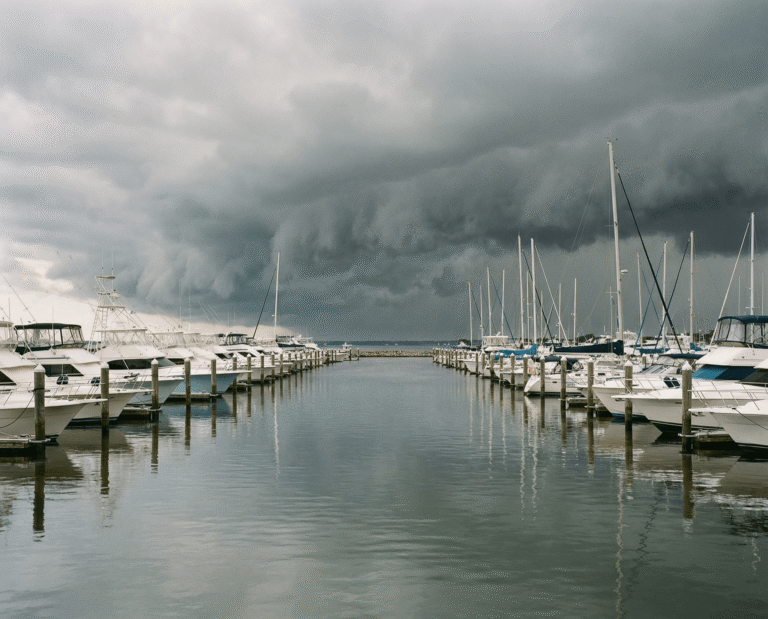
Wet slip boat storage earns through fewer units at higher per-boat prices. Slips command premium pricing and serve larger vessels that cannot be racked. They also anchor fuel and service income, along with transient dockage from visiting boats.
Both models feed the surrounding revenue stack. Fuel, service, and memberships apply on most sites. Retail and dining come into play on larger ones. That broader upside is part of why investors are paying attention to drystack developments as an asset class.
So, Which Makes More Money Per Square Foot?
Measured per square foot of land, dry stack produces more revenue for small-to-mid-size boats. Vertical stacking multiplies the number of paying customers on the same footprint, and no single slip rate can outrun that arithmetic at the volume end of the market. The comparison flips for larger vessels. A 70-foot boat cannot go in a rack, and it pays wet slip rates that no rack position can match.
There is also a measurement problem worth naming. The two models do not use the same square footage. Drystack consumes upland building area. Wet slips consume water frontage and submerged land. Sophisticated developers compare revenue against the site’s actual constraint rather than a single per-foot number. On one parcel the constraint is upland acreage. On another it is shoreline length or entitled capacity. This is why the dry stack vs wet slip storage question has no universal answer. It only has a site-specific one.
The Cost Side: Density Isn’t Free
Revenue per square foot only matters net of what it costs to produce, and the two models carry different cost structures.
Dry stack capital costs. The building is the big line item, along with the racks and the handling equipment inside it. The choice between forklifts, cranes, and automated systems shapes both the budget and the throughput, which is why lift system selection happens early in planning.
Dry stack operating costs. Moving boats all day takes trained operators and machines that need maintenance. The structure itself carries utilities and insurance. Throughput is a real operating discipline, not an afterthought.
Wet slip capital costs. Docks and pilings drive the budget. Dredging and seawall work add to it on many sites. So do utilities run out over the water, and submerged land leases where they apply.
Wet slip operating costs. Handling labor is lower because the boats stay in the water. Dock maintenance never ends in a marine environment, and insurance reflects the exposure.
The storm variable. A boat tied to a dock rides out a hurricane exposed to surge, wind, and whatever breaks loose around it. A boat inside an engineered concrete drystack building does not. Marina Partners built Rose Marina on Marco Island to withstand category 5 hurricane force winds, and that kind of hurricane-resistant marina design shows up in insurance costs and in what owners will pay for protected storage.
Why the Best Answer Is Usually a Mix
Most high-performing marinas are not a pure bet on either model. They are a program mix engineered to the site and the market. Dry stack density serves the volume segment. Wet slips serve larger vessels and premium customers. Service and amenity revenue layers across both.
The right ratio falls out of feasibility work. Demand by vessel size in the local market sets one boundary. The parcel’s upland-versus-waterfront geometry sets another. Entitlement constraints and modeled returns under different program scenarios settle the rest. This is the front end of the marina development process, and it is where the money question actually gets answered.
The mix decision comes before design because it shapes the building, the docks, and the pro forma at the same time. This is the core of Marina Partners’ Site Acquisition & Drystack Feasibility work: answering what the program should be and why, with modeled performance and scenario sensitivities, delivered as part of turnkey development.
FAQs
Is dry stack storage more profitable than wet slips?
Per square foot of land, it usually is for small-to-mid-size boats, because stacking multiplies rental units on one footprint. Wet slips earn more per boat and hold the market for vessels too large to rack.
Why do wet slips cost more than dry stack storage?
For owners, monthly rent is often comparable, but the ownership math changes once a boat lives in the water. Bottom paint and hull cleaning add costs that racked boats avoid. For marinas, slips carry marine construction and dock upkeep that a rack building does not.
What size boats can go in dry stack storage?
Most facilities rack boats into the mid-30-foot range. Advanced handling systems now store vessels up to about 60 feet. Beyond that, wet slips are generally the practical storage option.
Is dry stack storage safer than a wet slip in a hurricane?
A boat inside an engineered concrete building rated for hurricane winds is better protected than one tied to a dock. Wet slips leave vessels exposed to storm surge and wind-driven debris.
How do marina developers decide between dry stack and wet slips?
Through feasibility. They study demand by vessel size and the geometry of the site. Entitlements and modeled returns under different program scenarios point to the ratio that performs.
Find the Mix Your Site Should Be
The choice between a wet slip and drystack marina comes down to what your property can support. Feasibility determines which model, or which mix, is right for your site. Marina Partners develops the optimal program based on your property’s capabilities and delivers it through integrated design-build development. Start the conversation about what your waterfront should be.
Get in Touch
Ready to plan, build, or evolve your marina? Connect with Marina Partners to discuss drystack development, marina infrastructure, or integrated waterfront projects—delivered with clarity, accountability, and long-term performance in mind.