
Crane vs. Forklift vs. Automated Systems: Which Boat Lift Is Right for Your Marina?
In a drystack marina, the handling system is the decision that sets everything else. Marina boat lifts decide how many boats fit on the parcel, how long a member waits on the dock, and how much the system pays back. The short answer to the question in the title is that it depends on the site and the business model. Business owners, developers, and investors should settle on both before the blueprints are drawn. Here is how each system works, where it falls short, and how to choose the best for your build.
What Are the Main Types of Boat Lifts for Marinas?
Boat lifts for marinas come in three main types: marina forklifts, crane-based systems, and automated storage and retrieval systems. Each moves boats between racks and water with its own capacity, speed, labor, and cost.
A note on scope. This post covers commercial marina handling systems, not the dock lift or davit at a private home; “boat lift” means different things to a homeowner and a marina operator. And none of the three is best in the abstract. The “correct” one fits the site, the vessel mix, and the business model.
Boat Forklifts: The Industry Workhorse
The boat forklift is the most common handling system in dry stack marinas. It’s a purpose-built machine with negative lift, meaning the mast can drop the forks below the seawall to reach a boat in the water.
- How it works: An operator slides the forks under the hull, backs the boat off its rack, and carries it to the seawall, where the forks drop below deck level to set it in the water. Retrieval runs in reverse.
- Strengths: Lowest upfront cost of the three and the approach the industry knows best. If one machine goes down, a second must keep the marina open and running.
- Trade-offs: Capacity shrinks as the mast rises, so the top racks are limited to lighter boats; Marina Dock Age calls the result a triangular void of rack space that earns nothing. Forklifts need wide aisles, and diesel units bring noise and exhaust that neighbors notice.
- Best fit: Sites with room to spare and owners who want the lowest capital outlay and the most flexibility. Hamilton Harbor Yacht Club in Naples stretches the model: a wide center aisle and one of the industry’s largest marina forklifts let it store boats larger than most dry stack facilities handle.
Boat Lift Cranes: Height, Weight, and Density
A boat lift crane is a bridge or gantry system that travels above or alongside the racks. Because it lifts from the structure or from floor rails rather than from a counterweighted vehicle, it can serve taller racks and heavier boats than a forklift.
- How it works: An overhead bridge crane rolls along runway beams built into the building; a ground-mounted crane runs on floor tracks with a rotating column and forks. Either one carries the boat down the aisle and sets it in the water or passes it to a launch elevator.
- Strengths: A crane lifts the same size and weight of boat to any rack, so the void a forklift leaves at the top disappears. Narrower aisles mean more boats per acre or bigger boats in the same footprint.
- Trade-offs: An overhead crane adds weight at the top of the building, and the structure has to be designed and paid for around it. With no spare crane in the yard, preventive maintenance is not optional.
- Best fit: Constrained parcels where height and density carry the pro forma, and fleets with heavy boats you want on upper racks. An overhead crane also frees the ground floor; F3 Marina in Fort Lauderdale used an automated one to fit parking and offices under the racks.
Automated Boat Lift Systems: Storage and Retrieval Without the Operator
An automated boat lift system moves boats between racks and water by machine, with no operator handling each move. To a homeowner, an automatic boat lift is a powered dock lift at the end of a pier; in a marina, it means an automated storage and retrieval system, the same idea that runs high-bay warehouses.
- How it works: Boats rest in cradles, and a computer-controlled stacker crane pulls the cradle from its bay and carries it to a launch elevator or conveyor at the water. Sensors guide each move, and staff supervise from a control station.
- Strengths: The machine places a boat the same way every time, and operators report less damage than with manual handling. It shrinks the drive aisle, and some systems store boats more than one deep in each bay, pushing density past single-deep racking.
- Trade-offs: Highest upfront capital of the three, and the building has to be designed around the system from the first sketch. Because one system does all the work, uptime rests on a disciplined maintenance program, not on a backup machine.
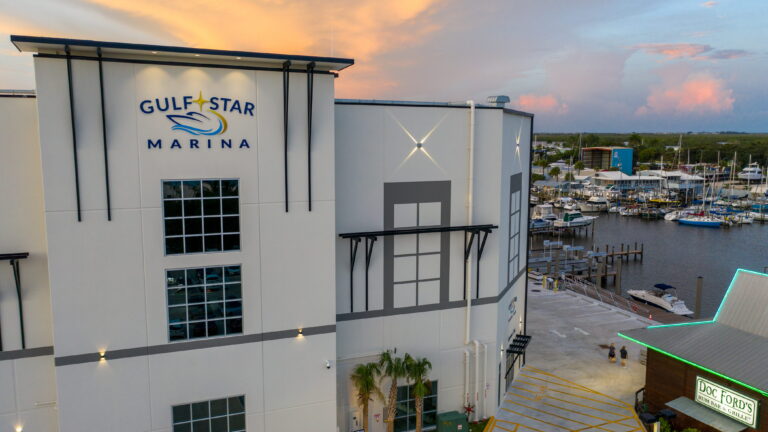
- Best fit: High land-value sites where every added rack pays. ASAR™, the platform developed by the team behind Marina Partners, is the example we know best: it runs Gulf Star Marina in Fort Myers Beach, the world’s first “Smart Marina,” and the same approach is spreading to vehicle and other high-value asset storage.
How to Choose: Matching the Lift System to Your Site and Business Model
The right choice among marina boat lifts falls out of the site and the pro forma, not out of a preference for a technology. Start with the parcel: how much land is there, and how high can you build? A tight lot with a generous height limit pushes toward a crane or an automated system, because the revenue has to come from density. A wide site with a low height cap takes that advantage away, and a forklift building becomes hard to beat on cost.
Then look at the boats and the calendar. Target vessel sizes decide whether the upper racks can hold paying customers. Peak-demand throughput matters more than the average; a holiday weekend with a line at the dock is when the system gets judged. Automation shifts cost from ongoing labor to upfront capital, and it changes what you sell: a boat that is in the water on arrival is a different product than one that waits behind a forklift.
Last, is the project ground-up or a retrofit? Rack geometry, aisle widths, and floor loads all follow from the lift. That is why this evaluation belongs in feasibility, before the building is designed: the handling system shapes the structure, not the other way around. Marina Partners runs Lift System Selection inside that process, weighing automated, crane, and forklift systems on a build-to-suit basis.
FAQs
What type of boat lift do marinas use?
Most dry stack marinas use negative-lift forklifts. Cranes and automated systems are the alternatives, and they show up most on dense urban sites and where larger boats are stored.
How does a boat forklift work?
A boat forklift slides its forks under the hull, lifts the boat off its rack, and drives it to the seawall. Its mast then lowers the forks below deck level to set the boat in the water.
What is an automated boat storage system?
A computer-controlled system that moves boats between racks and water without an operator handling each move. Boats ride in cradles carried by a stacker crane, with staff supervising from a control station.
Are automated boat lift systems worth the cost?
On a constrained, high-value parcel, the added capital tends to pay back through more rentable racks and less damage. On a large rural site with cheap land, a forklift or a simple crane may pencil out better.
Can an existing marina change its lift system?
Yes, within limits. Swapping forklifts for a ground-running crane can happen inside an existing building, but moving to an automated system means new racks and, in practice, a structure designed around the equipment.
You’re Choosing a Business Model, Not Equipment
Choosing between boat lifts is choosing your marina’s business model. Marina Partners evaluates automated, crane, and forklift systems on a build-to-suit basis. The analysis weighs throughput, safety, and long-term operating cost within integrated feasibility and design-build delivery. If you have a site in hand, start the conversation and we will help you find the right handling system.
Get in Touch
Ready to plan, build, or evolve your marina? Connect with Marina Partners to discuss drystack development, marina infrastructure, or integrated waterfront projects—delivered with clarity, accountability, and long-term performance in mind.